Coding Classes for Kids and Teens in Singapore

Submitted by KiasuEditor
In an era where AI can write code, many tech-savvy parents are rethinking the push toward coding classes for their children.
After all, if machines can automate so much — from debugging to entire app builds — does it still make sense for kids to spend hours learning Python or other programming languages?
At KiasuParents, we believe there’s still great value in letting younger children and teens take coding courses today. Read on to find out why!
Is coding still worth learning?
Recent research does show that coding-related activities help build important thinking skills, supporting learning across different subjects.
Let’s look at a study published in 2025, involving nearly 200 preschoolers in China. It compared three types of early programming exposure: unplugged activities (coding logic through cards and physical games), robot programming (giving robots step-by-step commands) and regular kindergarten lessons.
After 12 weeks, the children in the robot-based group showed the greatest gains in working memory, inhibition (the ability to pause), and cognitive flexibility. These are known as executive function skills, which are linked to better problem-solving in maths and writing.
Why do programming activities work well for learning? It’s because children can see the consequences of their commands immediately. For instance, when a robot doesn’t behave as intended, children must find the mistake and adjust their instructions, which is a very real form of debugging. It’s still coding logic, just made tangible and rewarding.
Even as children get older and start using AI-powered tools, these trial-and-error skills remain relevant. Yes, AI can now generate working code in seconds. But humans still need to understand whether the output makes sense, why the errors occur, and how to fix them. Coding teaches kids to think critically about technology. In other words, they learn to question, tweak, and improve technology, rather than assume the computer is always right.
For forward-looking parents, that’s the main benefit of coding lessons. Not training software engineers early, but raising young people who can engage thoughtfully with the digital world and shape it, instead of just consuming it.
What types of coding classes are available for kids and teens in Singapore?
In Singapore, coding classes for preschoolers and school-aged children typically cover the following areas:
Coding logic and foundations
These lessons introduce computational thinking without overwhelming younger learners. This includes:
- Unplugged coding: hands-on activities that simulate coding thought processes using cards or board games.
- Block-based coding: drag-and-drop platforms such as Scratch and Minecraft Education.
Where to find this: Terra Minds offers unplugged coding workshops, and Empire Code runs foundational programmes using Scratch and Minecraft Education.
Robot programming
Unlike robotics, which involves building or engineering a physical robot, robot programming is about writing the logic and commands that control how the robot behaves.
In other words, children write commands and see a robot respond. This reinforces cause-and-effect learning, which is particularly motivating for younger learners and tactile thinkers.
Where to find this: Newton Show Camp and The Lab offer programmes that use Lego Robotics.
Text-based programming
This level is suitable for tweens and teens who are ready to move beyond drag-and-drop platforms into real programming languages. Students learn to write and debug actual code, strengthening their logical thinking and problem-solving skills as they build simple games, apps, or digital tools.
Where to find this: Most children’s coding schools don’t teach advanced or syntax-heavy languages like C or C++. Instead, you’ll more often find schools like Kodecoon Academy and Computhink, which introduce coding through HTML, CSS, JavaScript, or Python — languages that are more accessible and engaging for young learners.
Game, web, and app development
Classes for teens tend to focus on creating a product, be it a game, mobile app, or website. Platform examples include Roblox Studio and Unity.
Where to find this: Many Singapore coding schools such as The Young Maker offer roadmaps for progression, with an emphasis on real-world projects. After all, coding isn’t a goal on its own; the aim is to use it as a tool to create something meaningful, such as a digital solution to a problem.
Physical computing and maker tech
Tweens and teens may enjoy learning how code interacts with hardware. This could involve working with motion sensors, lights, or simple robots that move or react to input.
Where to find this: Nullspace runs hands-on engineering classes using micro:bit and Arduino kits, teaching students how code can power real-world interactions like activating sensors and lighting systems.
Data literacy and AI
As AI becomes more common in daily life, many coding programmes now introduce students to how computers use data to learn and make decisions.
Where to find this: LCCL Coding Academy has a learning roadmap that includes data analytics and AI.
For advanced learners
Harvard’s Computer Science 50 programme (better known as CS50) is a great next step.
It's a free, university-level course that’s famous for its engaging, funny, and down-to-earth teaching style. It challenges students to think like computer scientists while keeping the learning experience surprisingly fun and relatable.
What if my child is interested in DSA for coding and robotics?
Most parents enquiring about this would be looking at the Direct School Admission or DSA process for secondary schools.
First, you should identify the talent area that your child is interested in, such as:
- Coding
- Computational thinking skills
- Infocomm
- Robotics
- STEM
- Science
You can use the Ministry of Education’s SchoolFinder tool to look for talent areas that match your child’s passions. From there, you should shortlist schools of interest, and explore each school’s programmes and DSA requirements.
Another approach is to find an experienced enrichment provider to support your child through the DSA.
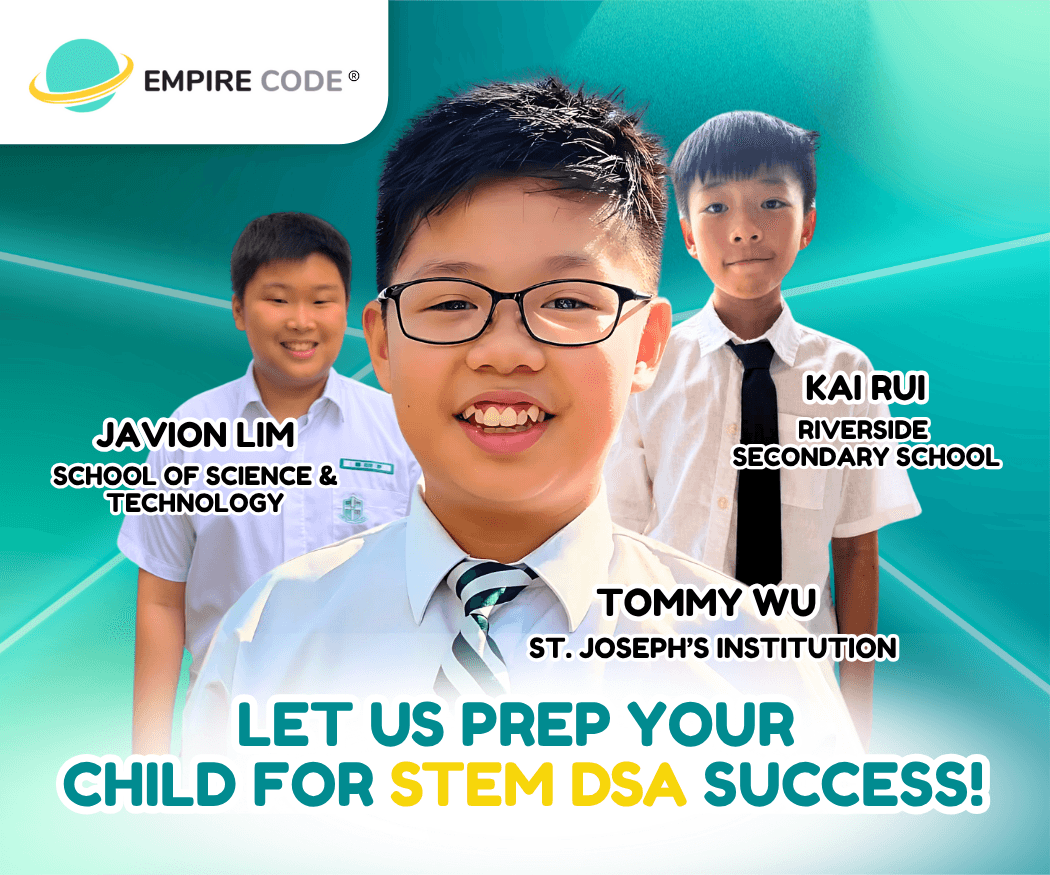
Since 2016, Empire Code has helped primary school students prepare for the STEM DSA — they know what top schools look for, and how to help your child stand out.
Empire Code’s STEM DSA Preparation Programme is designed specifically to help Primary 6 students curate a strong STEM DSA portfolio, which highlights their technical and presentation strengths through hands-on, well-curated projects guided by MOE-registered educators.
The centre’s track record includes successful DSA placements at top schools like SJI, NJC, NUS High, Nanyang Girls, and SST.
To find out more, book a complimentary consultation with their STEM DSA specialist.
Want to chat with other parents about coding classes? Start a conversation on the KiasuParents forum!
This article contains sponsored content.


