
Trying to help your primary schooler with English composition writing, but feeling overwhelmed by all the advice from teachers, tutors, and online experts?
First, it's not easy to tell a good story, and even adults struggle to do this well. So do be understanding, and keep your expectations realistic for your kids.
Below, we look at some myths about 'good writing' commonly held by Singapore parents, as well as tips for developing a child's writing skills.
Aim for a clear, interesting story rather than a masterpiece; even adults find good storytelling hard.
"Said" is perfectly fine, there's no need to memorise dozens of replacements.
Idioms and elaborate phrases aren't essential; original and simple writing can score just as well.
Get the basics right first (spelling, punctuation, grammar, and paragraphing) before higher-order techniques.
Build stronger writers over time through audiobooks and podcasts, playful language at home, and a personal store of favourite phrases.
Sponsored
Every strong composition begins with a clear idea, shaped carefully into a story. At Academia, students learn how to plan narratives, develop meaningful details, and use language with purpose. Our Primary English curriculum combines well-crafted examples, guided feedback, and structured writing practice to help students grow from tentative writers into more thoughtful storytellers. From regular school assignments to PSLE composition, students build clarity, confidence, and control in their writing.
Myth: The word "said" is bad and always needs to be replaced.
Many of us remember this piece of writing advice from our school days, but is this tip really useful?
Let's look at an essay from The Atlantic, titled "What Bobby McIlvaine Left Behind." It's about a family drama surrounding the diaries of a 9/11 victim, and in it, the word "said" appears 26 times. In fact, the word "says" is used even more liberally — 46 times! But read or scan the story for yourself, and see if this bothers you. Chances are, you won't even notice.
Of course, it can be useful to occasionally replace "said" with something appropriate for the situation, such as: "Don't worry about it," she cooed. But there's really no need to make a child memorise 200 ways to replace "said," or to set rules such as "Don't use 'said' more than once."
If you fixate on "said," you will most certainly make storytelling less fun for your child. At the same time, it will probably not result in a much better story. Sticking with "said" will help your child to save time that can be put to better use elsewhere.
Myth: To be descriptive, use idioms wherever possible.
You may have heard that one should use idioms in writing. But just as many people will tell you that a phrase such as "curiosity killed the cat" will make a piece of writing seem unoriginal or even cringe-worthy, and should be avoided.
What's the alternative? Going back to our example article (mentioned above), we can see that it kicks off with an interesting description:
"…his desk at home was a study in plate tectonics, coated in shifting piles of leather-bound diaries and yellow legal pads."
This is an original description, and it demonstrates what writing teachers mean when they say "show, don't tell." A budding writer might want to collect descriptions such as these for inspiration, but do children need to aim this high for a school composition?
Bear in mind that while many writers agonise over each phrase that goes into a story, your child is taking a stressful exam with a time limit. To be fair to your child, the goal should only be to produce a reasonably clear and interesting story, as opposed to a masterpiece.
As for common phrases, there is usually more than one way to use them in stories, and again this will be subject to an individual's skill and preference. If your child decided to write "He blew his top again…" it would not be wrong to do so.
Other alternatives might include:
"His volcanic temper tantrums made everyone afraid of him."
"You could say he was like a volcano, because no one knew when he was going to erupt."
Which is best? One perspective would be that there is no best way to describe something. The more important factor is the entire story and how it unfolds, and whether it offers any surprises or insights, or at least enough substance to keep an examiner engaged. This can be achieved with simple, no-frills writing as well.
Myth: Kids must learn about 'good writing' from model composition books.
If you've read model composition books, you'll know that they often contain exaggerated descriptions such as "a raging inferno that was engulfed in cantankerous flames."
What's wrong with the above phrase? Well, an inferno already refers to a large, uncontrolled fire, so technically, "raging" is redundant. But more importantly, you wouldn't say "a fire was covered in flames," therefore it's also inappropriate to say that an inferno was "engulfed in flames."
If you examine the writing in model composition books carefully, you'll likely find several word usage issues and contradictions, such as "a stern-looking man sauntered." ("Saunter" means to walk in a slow, relaxed manner).
That said, model compositions aren't worthless. The catch is that the writing can be uneven, so it's better if someone who knows the language well vets the material first.
Sponsored
What are good phrases for composition to teach my child?
Instead of memorising specific phrases to impress examiners, students should consider phrases that are linked to writing techniques (e.g. to express a character's emotions through the "show, not tell" method, students can use good phrases to describe body language, actions, and expressions). These phrases can be used across different topics and scenarios. Students should also be mindful that not all colourful vocabulary can be force-fitted into any composition. They should start with a good understanding of the topic words and selected pictures before consciously incorporating suitable vocabulary, phrases, and language techniques into their composition.
What are the common PSLE composition topics?
Recent topics tend to revolve around themes of personal growth and moral values.
Where can I find good model compos?
Model compositions are available to our students. They can also find model compositions online or in assessment/guide books at bookstores. Students should not blindly memorise model compositions. Instead, they should focus on analysing the writing techniques used and understanding how descriptive vocabulary and vivid expressions are applied appropriately within the context of a given topic. This will enable them to adapt these techniques effectively in their own writing rather than merely reproducing memorised content.
What to focus on instead
Some writing basics that should be in place before moving on to higher-order skills include:
Spelling
Punctuation
Grammar
Paragraphing: for dialogue, as well as to organise ideas
For those who have stronger language skills, they can boost their composition score by:
Thinking up refreshing ways to begin a story, rather than "Ring! Ring! The alarm clock rang. I woke up…"
Using a wide range of "show" phrases to help the reader better understand what the main character is going through.
Setting up a conflict for the main character, where there are stakes involved, i.e. something to be gained or lost.
Using relevant details, to advance the plot in a logical way.
Providing a satisfying resolution to the story, e.g. closure for the main character, usually a lesson learned.
Below, we have three suggestions that we believe are beneficial for children in the long run, beyond scoring well for composition tests and exams.
Listen to audiobooks and podcasts
Reading shouldn't feel like work. Yet for many kids, it is.
If this is your child, you now have the option of letting them listen to audiobooks and podcasts, and many of these can be accessed for free. Here are some benefits:
It removes the effort of sounding out words, and helps kids to quickly learn and adopt the correct pronunciation for longer new words.
It may improve comprehension and vocabulary acquisition.
It's easier for kids to focus and immerse themselves in a story, and listening may feel like less of a chore compared to reading.
Listening to audiobooks can be a way to help kids ease into more challenging texts, such as the classics, or any book that they deem "too difficult." They can also read the print version of a book while listening to the narration at the same time.
Be creative with language in speech
You may find words like "aggrieved" and "apprehensive" on your child's vocabulary lists from school, but if such words aren't commonly used at your dinner table, it's unlikely that your child will feel comfortable using them in a composition.
We encourage parents to use conversations as a means to improve one's language skills. For instance, if your child makes a mistake in speech, don't let it slip by, because these same mistakes may appear in your child's writing as well. Instead, ask your child to have another go at using the correct or appropriate expression, or simply rephrase the sentence in the correct form, for your child's benefit.
If it's vocabulary development you're concerned with, do make it a point to introduce new words during mealtime conversations, and encourage the family to do the same. In time, the dinner table will become a safe space for everyone to try out newly acquired words.
To be a better writer, find a way to store 'good phrases' for future reference.
Many of us read great stories, but it doesn't mean we'll be able to apply it to our own writing. That said, we can always work to improve ourselves, and if you want your children to be intentional about this, you can ask them to highlight the phrases that they like in their books, and find a way to store these phrases so that they can be easily accessed when they're writing a new story.
Some ways to record these 'good phrases' could be in a notebook, in an app, or simply in an Excel document such as this:
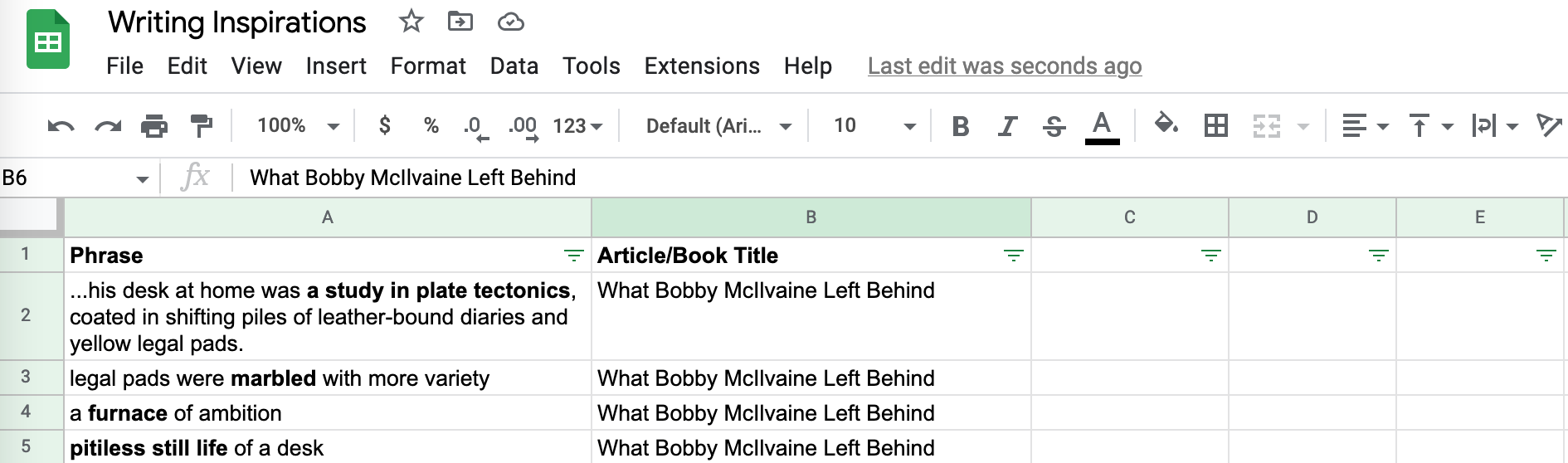
While your child shouldn't plagiarise someone else's work, a collection of choice phrases can provide ideas for playing with words.
Want more English composition tips from parents? Join the conversation on the KiasuParents forum!