Math Questions involving Changed Quantities

Submitted by
 Questions involving changed quantities appear regularly in top school test papers. Some call it all changing quantities,changing variables/quantities, everything changes, and they mean the same thing.
I’ve spent some time combing through KSP forum to compile a list of questions on changed quantities. Generally, they share some common characteristics, initial or before ratio, changes (addition/subtraction) and then followed by the final or after ratio.
Questions of such category can be solved with MD, SL or UP.
Units and Parts are used to differentiate the initial and final ratios. Some books just use the numbers of the ratios. It’s your preference.
In finding out the value of the initial unit, there are alternatives, use the method you are comfortable with. Here again, some may prefer to call it equalising the parts or cross multiplying.They serve the same purpose, to compare so as to find the initial unit.
I’ve used this question as an illustration, hope you find it useful.
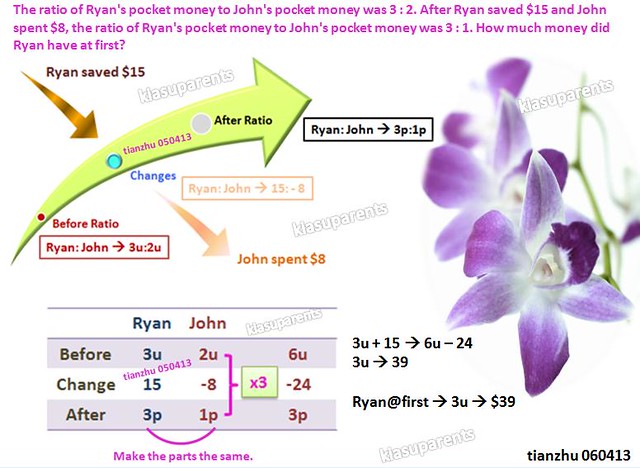
The ratio of Ryan’s pocket money to John’s pocket money was 3 : 2. After Ryan saved $15 and John spent $8, the ratio of Ryan’s pocket money to John’s pocket money was 3 : 1. How much money did Ryan have at first?
Some students may prefer to present the solution in a table format as shown below or simply without it as follows:
Before
Ryan:John ——3u:2u
Changes
Ryan:John ——15: – 8
After
Ryan:John ——3p:1p
3u + 15 —— 3p
2u – 8 ——- 1p
(x3)
6u -24 ——-3p
Make the parts the same.
3u + 15 —— 6u – 24
3u —— 39
Ryan@first -> 3u -> $39
Revised list of questions on Changed Quantities
1)Bala and Dan shared a number of stickers in the ratio 3:4. After Bala and Dan bought another 19 stickers and 2 stickers respectively, the ratio becomes 4:3. How many stickers did Bala have at first?
2)A container contains a number of chocolate and banana muffins in the ratio 5:2. After removing 10 chocolate muffins and adding another 4 banana muffins, the ratio became 3:2. How many chocolate muffins were there in the container in the end?
3)A box contained a number of 20 cent and 50 cent coins in the ratio 3:4. When ten 50 cent coins were taken out and replaced by 20 cent coins, the ratio became 7:5. Find the sum of money in the box at first?
4)There were 3/5 as many adults as children on a bus. At the next stop, 6 adults and 4 children boarded the bus. As a result, there were 3/4 as much adults as children on the bus. How many people were on the bus then?
5)There are 4 times as many red pens as blue pens. 415 red pens and 46 blue pens were removed. As a result, the number of blue pens is 3 times as many as red pens. How many blue pens were there at first?
6)A box contained 50cent coins and 20 ct coins in the ratio of 2:3. When I took out four 50ct coins, exchanged them for 20ct coins, and then put the money back into the box, the ratio became 2:7. Find the sum of money in the box.
7)The number of grey marbles to black marbles in a bowl was in the ratio of 4:5. Later, 8 grey marbles were taken out and 20 black marbles were added into the bowl. After that, the ratio of grey marbles to black marbles became 4:11. How many marbles of each colour were in the bowl in the end?
8)The ratio of Ryan’s pocket money to John’s pocket money was 3 : 2. After Ryan saved $15 and John spent $8, the ratio of Ryan’s pocket money to John’s pocket money was 3 : 1. How much money did Ryan have at first?
9)The number of Malvin’s stamps to Ken’s stamps was 2:3. After Malvin bought another 8 stamps and Ken lost 5 stamps, Malvin now has 4/5 as many stamps as Ken. Find the total number of stamps the two boys had at first.
10) A coin box contained only twenty-cent and fifty-cent coins in the ratio of 4:5. When 16 fifty-cent coins were taken out and replaced by some twenty-cent coins, the number of fifty-cent coins left in the box was 7/8 of the twenty-cent coins. The total value of all the coins remained the same. Find the sum of money in the coin box.
11) At statio A, the ratio of the number of children to the number of adults on a train was 4:5. At the next station, 12 children alighted and 10 adults boarded the train. The ratio of the number of children to the number of adults on the train then became 7:10. How many children were on the train at first?
12)The number of 20cents coins to $1 coins in Jane’s box is 5:4. She took out 8 $1 coins and exchanged them into 20 cents coins of the same value. The ratio of the number of 20cents coins to $1 coins became 15: 4. What was the amount of money Jane has?
13)In a concert, 75% of the audience were female. 75 females and 5 males left the concert half way. The remaining audience were allocated seats in groups of 10. Each group has 3 males. How many people were in the audience at first?
14) 80% of marbles are red marbles and 20% of them are blue marbles. 63 red marbles and 46 blue marbles are added. The red marbles now makes up 75% of marbles and blue marbles 25% of marbles. How many red marbles are there at first?
15) There were some marbles at a shop. The ratio of the number of red marbles to the number of blue marbles was 2:3. When 50 more red marbles and 30 more blue marbles were added, the ratio of the number of red marbles to the number of blue marbles became 5:6. How many marbles were there at first?
16) Grandma had some yellow and purple sweets in the ratio of 9:7. On Monday, she made 54 more yellow sweets. On Tuesday she gave away 44 purple sweets and sold 129 yellow sweets. The number of yellow sweets to the number of purple sweets became in the ratio of 6:5. How many yellow sweets are there in the end?
Best wishes