

PSLE resources
Find all our latest PSLE guides, tips, and revision tools on the KiasuParents PSLE page.
Is it normal for parents to feel overwhelmed in the weeks leading up to the PSLE?
Yes, of course! Simply ask the parents around you, and you’ll probably realise that many others are feeling some level of anxiety, especially if they are invested in their children’s education.
Don’t be embarrassed by your feelings, or try to suppress them. The PSLE is a milestone exam, and this often comes with expectations and pressure for both children and parents. It’s natural to experience a range of emotions as you help your child through the preparation process. In fact, acknowledging your feelings is the first step to self-care, and caring for yourself will allow you to be a more present and supportive parent.
Below, we outline some PSLE revision scenarios that can lead to stress at home. We'll suggest what parents can do to minimise mental load, and help their children feel better too!
Tame the information overload: use a free productivity app to organise school updates, or deliberately cut your exposure to information and lean on the class chat.
If a resource makes you or your child feel bad, don’t use it, and look for gentler alternatives that don’t induce dread.
Reframe what worries you: if another Primary 6 child seems more prepared, remind yourself that your child still has time.
You don’t have to be the teacher: try working alongside your child as a fellow learner.
01 Scenario 1: There are too many updates from the school, with instructions and resources to download. I feel disorganised!
It can be disorienting to receive regular updates from the school. You may be getting school messages from ParentsGateway, as well as other channels. The reality is that some parents step in to help their children manage the information overload, while others have tuned out completely.
Ultimately, you do have a choice. If you believe the information is useful and wish to track it, you can use free productivity apps like Notion to stay organised. For instance, you can create simple revision checklists for your child to go over school materials, and customise your dashboard to look visually appealing for both you and your child.
You can also create your own template to track weekly updates from subject teachers:
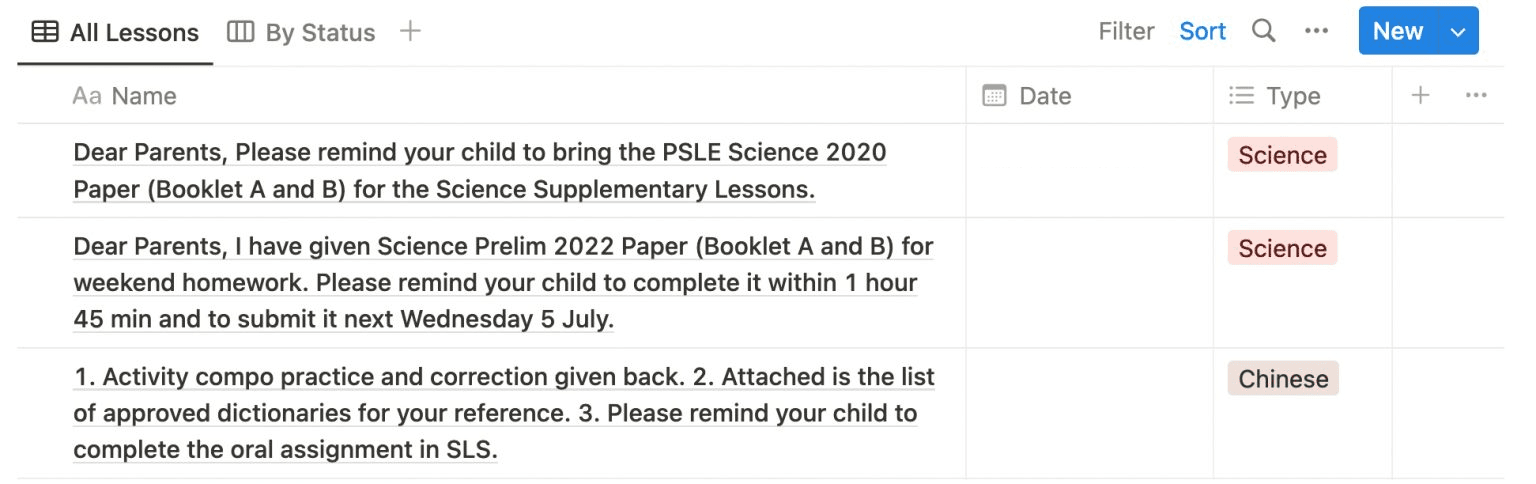
Depending on your personality, the act of organising information can feel reassuring and therapeutic. You can also share your resource with other parents, or send it to your child’s tutors so that they can align their efforts with what the school is doing.
For busy parents, or parents who find dealing with information stressful, do yourself a favour and minimise your exposure to school updates. The class WhatsApp group can be a comforting network during this time. Post a question in the chat if you need help, and there is likely to be someone with a ready answer.
02 Scenario 2: My child has received thick booklets from the school filled with "model answers." He feels intimidated, and so do I.
Here’s a simple rule of thumb: if something makes you or your child feel bad, don’t use it.
Instead, look for alternative resources that don’t induce a feeling of dread, such as a book of sketchnotes or colourful revision flashcards.
It may also help if you reflect on your personal values regarding education. For instance, if you believe that a "model composition" doesn’t necessarily reflect good writing skills, it’s easier to let go of the need to fit the mould.
By not placing too much emphasis on things that won’t matter in the long run, you can save yourself plenty of heartache, and be of better support to your child.
03 Scenario 3: My child’s school is holding revision classes over Zoom, and I feel worried when I see her classmates answering questions confidently. They seem much more prepared for the exams than my child!
To feel less worried, you can reframe this situation for yourself and your child: it’s better to have a reality check while there’s still time to revise!
With Zoom sessions, there is usually the option to watch a recording instead, and this may work better for your child. For one, your child won’t have to worry about being called upon and looking unprepared.
Here’s a strategy that works for watching recorded lessons: If the teacher asks a question, your child can pause the video and attempt to answer the question. After which, she can compare it to the classmate’s answer, as well as the teacher’s recommendation. In this way, your child can simulate an interactive experience, which is better for learning.
04 Scenario 4: My child has completed a set of practice questions at home. Even though an answer sheet was provided, I find it daunting to mark his work.
It is stressful when we feel that we have to play the role of a teacher at home, for subjects that we haven’t studied in decades. It doesn’t help that some enrichment schools have taken to chastising parents for "making mistakes" and impeding our children’s PSLE progress.
But here’s the good news: You don’t have to be your child’s teacher. Rather, think of yourself as a fellow learner, working alongside your child. Instead of marking your child’s work, you can get your child to read his answer aloud, followed by the recommended answer. Then ask your child, "Is there any difference between your answer and the school’s answer?" This removes the burden of knowledge from you, and places the responsibility on your child to find ways to improve his work.
If your child has answered many questions inadequately despite having done some revision, you can ask him questions such as, "How did you revise for this topic?" or "This fact is in your revision notes. Did you read this section and quiz yourself?" This helps your child to assess if his earlier revision efforts were sufficient, and he can create a new plan to reread the topic with a different approach.
What can you do if your child is feeling demoralised that his initial revision efforts have not paid off? Tell him that information retention works much better with repeated exposure, and assure him that he’ll remember more by going through the material again.
Webinar recording
Calling all P6 parents! Are you:
Trying to balance your hopes for PSLE grades with keeping the peace at home?
Wondering how to keep your child motivated without piling on the pressure?
In this 90-minute conversation, you’ll find out:
💡 How parents can help children stay mentally tough when the last lap feels intense
💡 What study habits actually work, and what may create more stress
💡 How sleep, screen time, motivation, and parent-child communication affect PSLE preparation
Panellist: Edgar K. Tham, sport and performance psychologist with more than 30 years of experience helping people perform well under pressure and recover afterwards. Founder of the International Association for Performance Coaching and Facilitation (IAPCF) and an Associate Faculty member at the Singapore University of Social Sciences (SUSS).
Moderator: Carol Loi, Maxwell Leadership Certified Youth and Family Coach.
Want to chat with other parents about preparing for the PSLE? Join the conversation on the KiasuParents forum!