

(Q1) What are some of the most common types of careless mistakes students make in the PSLE Math Exam? Are there recommended strategies students can adopt to prevent careless mistakes?
Careless mistakes in the PSLE Math context can be broadly classified into 5 categories:
(A) Transfer errors
There are many ways transfer errors could happen. Perhaps a decimal point is misplaced, a number is transferred wrongly from one step to the next or the student keyed in the wrong numbers into the calculator.
How to avoid transfer errors?
Students are strongly encouraged to use the “Finger Trace” method which is commonly used to help reduce transfer errors. The student needs to physically put their non-writing finger at the original number or text, which anchors their eyes to it, and keep it there until they have finished copying it to the next line or keyed it into the calculator. This bridges the gap between seeing and writing, preventing the eyes from "skipping" over details.
(B) Misreading or misinterpretation of question
Students often rush through the reading process and miss crucial information in complicated word problems due to them reading or understanding the question wrongly.
How to avoid misreading or misinterpreting the question?
Being an “active reader” is a useful skill for all students. When they go through the question, they need to physically underline or highlight key information and details. Most importantly, they will need to circle what exactly the question is asking for in the end. For example, if the question is asking for the “unshaded area” of the figure, circling that information will prevent the student from giving the “shaded area” instead.
(C) Calculation mistakes
Arithmetic mistakes in basic operations sometimes occur due to rushing or anxiety. This is a common type of error, and it can be very frustrating for students who understand concepts well but lose marks due to calculation missteps.
How to avoid calculation mistakes?
Write down every single intermediate working step and never use mental calculations! Even if it is a simple calculation step like 12 + 15 = 27, write it down and use a calculator or separate arithmetic working to double check. When students use mental calculations, they do not leave a physical trail of their intermediate workings, and if a mistake had been made, they would not be able to find it later even when checking.
(D) Units conversion error
In the PSLE Math context, this is most commonly due to students forgetting to convert between units before calculation. Questions also often mix units, giving information in millilitres but asking for the answer in litres, or mixing minutes with hours.
How to avoid units conversion error?
If students spot different units, such as centimetres and metres, in the same question, they should underline or highlight them right away. Before starting any workings, it is recommended that they convert all values to the same unit. In most cases, converting to the smaller unit, such as metres to centimetres, helps avoid awkward decimals and reduces the chance of mistakes.
(E) Conceptual error
This can be quite difficult to identify and therefore correct. Making this type of error could mean that the student gets all the calculations right but still get the overall answer wrong because they are using the wrong concept or heuristic to solve it.
How to avoid conceptual error?
Conceptual errors usually occur when students focus on practicing procedures without fully understanding the underlying concepts. Without a strong conceptual foundation, they may struggle to apply what they know to unfamiliar problems or questions that require them to combine multiple concepts. By building strong conceptual foundations, procedural fluency follows naturally, and students develop the flexibility needed to tackle even unfamiliar PSLE Math challenges with confidence.

(Q2) What factors do you think contribute to these errors? Could it be due to test anxiety, overconfidence or time management issues?
Contrary to popular belief, being careless is not purely due to laziness, and it's not something we can just ignore and hope will magically disappear.
Instead, carelessness in the PSLE Math context usually boils down to hidden gaps like a lack of focus & exam stamina, exam anxiety, shaky foundations, jumping to conclusions, poor problem-solving habits or simply not having a proper checking system!
Always remember that accuracy is a skill, not an accident, so losing marks to careless errors is most definitely a fixable problem.
(A) Limited Focus & Exam Stamina
Even adults lose focus at work occasionally. Children, with shorter attention spans and weaker stamina, can be even more easily distracted. In an exam setting, all it takes is for the child’s focus to slip, a key detail to be missed, and marks are inadvertently lost.
(B) Exam Anxiety
High stakes exams can be very stressful, especially so for younger children. This can lead to emotional blocks preventing students from accessing knowledge they actually possess in an exam setting.
(C) Shaky Foundations
If a concept hasn’t been drilled until it’s second nature, exam stress can make it fall apart. What appear to be a “careless mistake” is often a sign that the topic has not been fully mastered, which could be due to over focus on procedural practice without ensuring strong conceptual understanding.
(D) Jumping to Conclusions
We all know that children love shortcuts. They find a question familiar, skim through it, spot a few keywords, and rush headlong into a method or heuristic they’ve used before.
But what could appear to be familiar at first glance, is actually testing something quite different, and the students end up using the working from an entirely different question to answer what they are actually facing in the exam.
(E) Poor Problem-solving Habits
Messy and unlabelled workings, skipping entire steps, relying on mental sums to save time. These are some habits of underperforming students, who mistakenly equate speed with excellence.
Without building consistent and structured problem-solving habits, exam results will end up becoming inconsistent.
(F) Not Having a Proper Checking System
Step 1: The "3-Second Reasonableness Check". Is the answer reasonable? Does it make sense? Did you get the age of the girl to be 250 years old? Or the number of boys in the class to be 5.76?
If you have sufficient time, you can proceed to step 2 & 3 after completing the whole paper.
Step 2: The "Fresh Mind Reverse-Calculation”. Instead of rereading your steps, approach the problem from the opposite direction to force your brain to process the data fresh. So if you did addition → check by subtraction; if you did multiplication → check by division.
Step 3: Use the “Substitution Test”. Substitute your final calculated answer back into the question and see if it fits.

(Q3) How can students manage their time effectively during exams to ensure they have enough time to check their work and catch errors?
PSLE Math exams demand not just strong math skills, but also strategic time management. Many students run out of time because they spend too long on challenging problems while rushing through the rest.
Students could use a very useful time management rule of thumb for their PSLE Math exam – they should be spending approximately 1 minute per mark.
So, a 2-mark question should ideally be completed in 2 minutes.
While a 5-mark question should not take more than 5 to 6 minutes.
This will give the students plenty of time to check their work or buffer for any unforeseen circumstances.
“Skip and Return” strategy : If solving a problem is taking too long, students are encouraged to mark it, move on, and return to it if time permits.
In addition, students should be given regular timed practice tests, to help them develop an intuitive sense of pacing, and recognize when they’re spending too much time on one question.
(Q4) What is the one most effective piece of advice you give your students just before they enter the exam hall to minimise careless errors?
Always remember that the PSLE examiners are trying their best to award you every single mark that you deserve, so don’t give them an opportunity to take those marks away!
If you feel yourself losing focus or starting to panic while doing a question, take a short 5-second time-out (close your eyes and count to 10, while taking one deep breath in and one deep breath out). This will help reset your mental state before reading the question again with a fresh eye.

NickleBee Tutors – Singapore’s Top Mathematics Training Centre for PSLE Math AL1 results, Olympiad Math medals & DSA Math success.
Want to help your high-ability Primary School child gain a Fast-Track Pass to TOP Integrated Programme Secondary Schools?
Ace PSLE Math, Olympiad Math and Direct School Admission (DSA) Math with the #1 rated Advanced Primary Math programmes by NickleBee Tutors, a popular math tuition centre for upper primary school students.
Experience Singapore’s Top Mathematics Training Centre for PSLE Math & Olympiad Math — trusted by over 800+ students since 2010, and home to 100+ Platinum, Gold, High Distinction awards & Top-Level winners in prestigious Math Olympiads such as APMOPS, NMOS, RMO, AMC and others.
While NickleBee Tutors is amongst the top in Singapore for our prowess in Olympiad Math, our students’ PSLE Math and DSA Math success is just as impressive! 9 in 10 of our advanced math students have attained an AL1 in PSLE Math since 2021, with 50+ of them securing DSA Confirmed Offers to top IP Schools!
ELITE EXPERTISE
The NickleBee Tutors Math programmes are led by Mr Zhou, an Alumnus of Raffles Institution (Gifted Education Programme) and National University of Singapore.
He is a multi-award winning Math Olympiad Gold Medallist (Ranked 23rd in Singapore), High Distinction holder in the Australian Math Competition, and Distinction holder in the American High School Math Competition.
Mr Zhou is a member of the Association of Mathematics Educators (NIE) and a popular Math Olympiad Trainer & DSA Coach at top Primary Schools, with many years of experience in guiding GEP and High Ability students towards excellence in PSLE Math & Olympiad Math.
Mr Zhou has also been Featured Multiple Times in the Media and has received overwhelmingly 5-star Positive Reviews and Testimonials from Parents & Students.
PROVEN CURRICULUM
NickleBee Tutors equips all students with the necessary skills and confidence to tackle challenging math problem sums, by teaching elite-tier Advanced School Math and Olympiad Math skillsets such as investigative math, non-routine questions, higher-order thinking skills, creative problem-solving techniques and advanced heuristic tools.
Using NickleBee Tutors’ unique C3PO™ Problem Solving Framework and proprietary UNITARY™ Method, they ensure your child can solve even the most complex problems in the PSLE Math Exam and Math Olympiad Competitions swiftly and accurately.
REMARKABLE RESULTS
92% of NickleBee Tutors Advanced Math students scored the TOP AL1 grade for the PSLE 2025 Math exams!
ALL 100% of NickleBee Tutors 2025 Math Olympiad students won GOLD & HIGH DISTINCTION awards or better in the NMOS, APMOPS and RMO.
While they are rated #1 in Singapore for their prowess in PSLE Math & Olympiad Math, their students’ DSA success is just as amazing!
12 received Direct School Admission (Math) Confirmed Offers from TOP Integrated Programme Schools such as Raffles Institution, Hwa Chong Institution, Raffles Girls’ School, ACS (Independent) and NUS High in 2025.
PROGRAMME HIGHLIGHTS
NickleBee Tutors offers two class options:
Keen to give your child an unfair advantage in the PSLE Math Exam? Check out NickleBee Tutors flagship 12-month Advanced PSLE Math Masterclass programme, designed to help motivated learners achieve the TOP AL1 grade with confidence. Students learn advanced PSLE strategies to tackle challenging PSLE Math questions, and secure AL1 with ease. An astounding 92% of NickleBee Tutors Advanced Math students scored AL1 in PSLE Math 2025 (more than 10 X the national performance)!
NickleBee Tutors Small Group Math Tuition are conducted for students enrolled in their Advanced School Math, Olympiad Math, DSA Math & GEP Math courses, with dynamic and individualized classes tailored for students aiming to secure placement in top Integrated Programme (IP) secondary schools, through DSA Confirmed Offers, Math Olympiad Medals and PSLE AL1 scores!
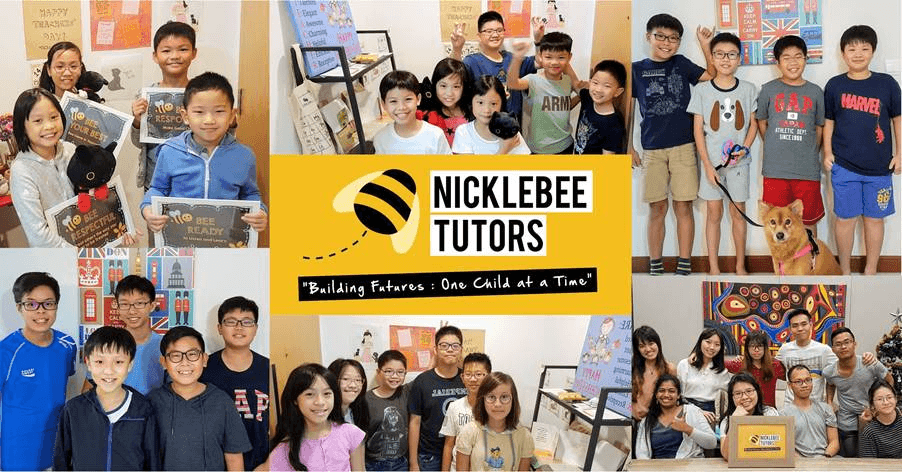
ABOUT NICKLEBEE TUTORS
NickleBee Tutors is Singapore’s premier PSLE Math & Olympiad Math Tuition Centre, and they have been featured in The Straits Times, The Sunday Times, The New Paper, Capital 958FM and Channel 8 for their comments on issues ranging from Challenging PSLE Questions to DSA Math preparation to Math Olympiad questions.
Visit https://nicklebeetutors.com/ to find out how NickleBee Tutors programmes have helped hundreds of students score the TOP AL1 grade in PSLE Math and win Gold & High Distinction awards in prestigious Math Olympiad Competitions.
Subjects : Primary School Math, PSLE Math, Olympiad Math, GEP Math, DSA Math
Where : 3 centres at Bishan, Bukit Timah, Sengkang
WhatsApp : +65 9188 4710
Find out more about math tuition at NickleBee Tutors: https://nicklebeetutors.com/