

After months of school, tuition, and revision, many Primary 6 children go from having a jam-packed schedule to having very little to do after the PSLE.
The post-PSLE break is three months long, and devices are an easy way to fill this time. If you are concerned about this, read on! Below, we answer the questions many parents are asking about their child's screen time and online safety during the post-PSLE break.
01is my child ready to interact with others in the digital world?
In a large British study that examined social media use and life satisfaction over time, researchers found that the link between increased social media use and lower life satisfaction was strongest for those aged 10 to 15. For girls, the worst years for using social media were 11 to 13; for boys, it was 14 to 15.
How is this relevant in Singapore? For our 12-year-olds in local schools, the post-PSLE period is from October till the end of December. During this time, children have almost no academic requirements to fulfil, and they may spend longer hours using their devices, especially social media apps. Some risks to highlight:
Kids can be affected by unkind comments from other users, comparisons with others, or content meant for adults.
Even non-social media apps (such as gaming apps) allow for contact from random strangers, including those with ill intentions.
With prolonged device usage over three months, one can develop unhealthy digital habits, which may be hard to correct.
A reminder for parents: Owning a phone and installing apps (including social media apps) are separate decisions. You may have given your child a phone for practical reasons, but this does not mean they should have unrestricted access to every platform.
What you can do
Together with your child, look through their phone apps and ask what each one is used for. In particular, check what your child posts, who can contact them, and what content is showing up on their feed.
If your child doesn't use apps that involve interacting with friends and strangers, the post-PSLE break doesn't need to be an automatic starting point. Talk to your child about privacy and safety, and what appropriate usage means.
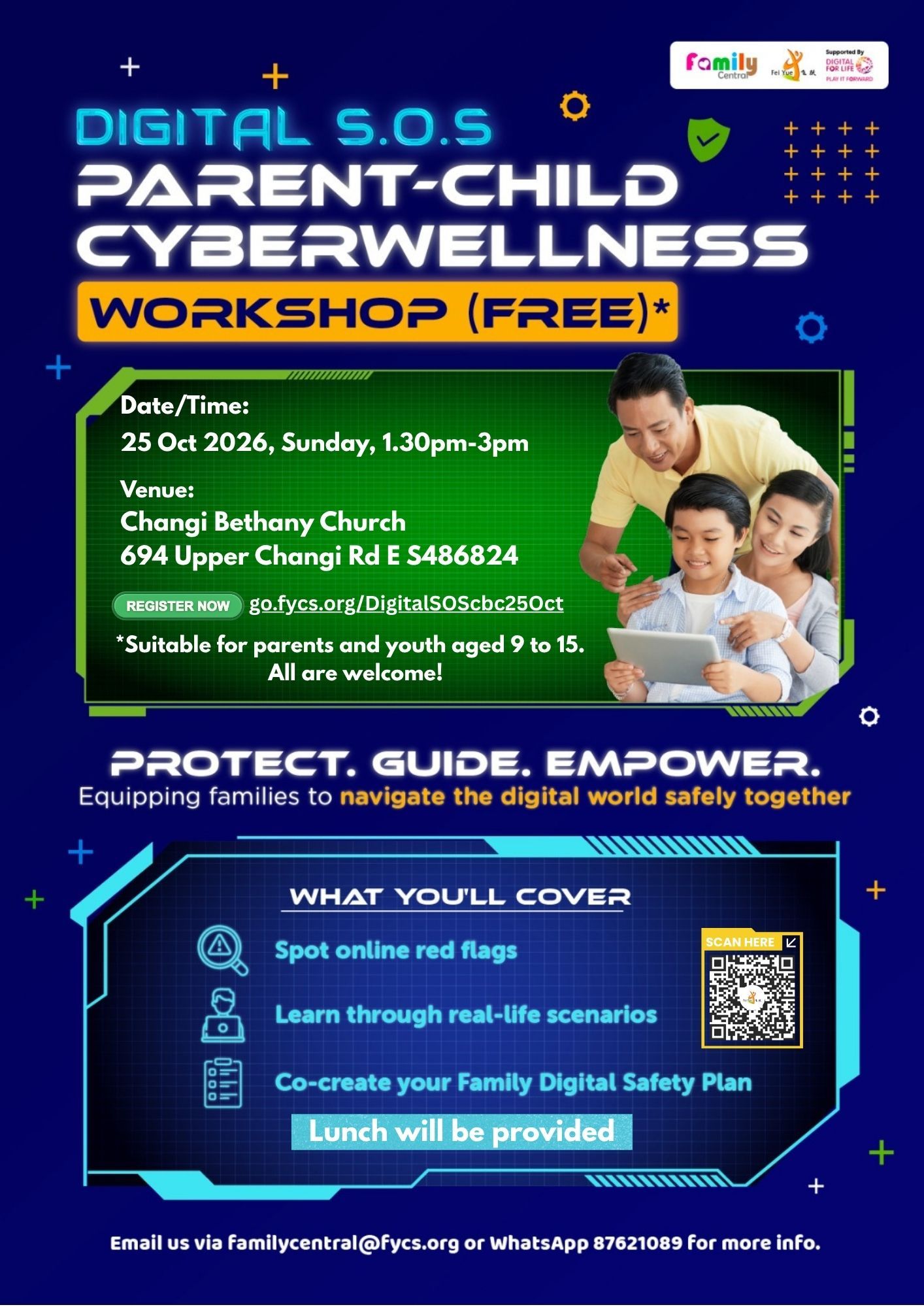
Need help to have these conversations with your child? Fei Yue Community Services has a free Digital S.O.S workshop (see below). This is a parent-child session that will walk you through some of the biggest digital dangers right now, and help you set up a safety plan to protect your children.
📖 For more on this, read The Anxious Generation by Jonathan Haidt
02 will my child spend too much time online?
How much screen time should your child have after the PSLE? Instead of worrying about "too much screen time," one approach is to work backwards.
First, map out the time needed for sleep, meals, chores, exercise, family activities, friends, and anything else that your child wants to do during the break. This makes it easier to see where gaming, videos, and social media can fit.
This approach is useful, because if a child is allowed four hours on their devices daily, they may treat all four hours as time they should use, even on a day when they might have put their devices down earlier.
A weekly plan also gives children flexibility. A long gaming session with friends on one afternoon may be workable if it does not push aside sleep, meals, exercise, or plans with other people. The same number of hours spent alone every night until 2am is a different problem.
Ideally, involve your child in the technology plan. As a parent, you should still decide the boundaries concerning safety, sleep, and family life. Children can help decide how the remaining time is arranged.
What you can do
Ask your child what they want from the break, besides using their phone. Put these activities into the week first. Then agree on where recreational phone use fits. Make it clear that the arrangement will be reviewed before Secondary 1 begins.
📖 For more on this, read The Self-Driven Child by William Stixrud and Ned Johnson
03what if my child can't control their device use?
Self-control is a skill strengthened through practice. In one experiment, a group of US college students practised self-control for two weeks by monitoring their posture or eating habits. Afterwards, they performed better on a separate self-control task than participants who had not done the practice.
Although this study wasn't about children or phones, the idea is still relevant. Putting a phone down at an agreed time is an act of self-control, and repeating it can help the action become familiar.
Changing where devices are used in the home can also make a difference. A phone on your child's desk creates repeated opportunities to check messages while they are reading, doing a chore, or talking to someone. Keeping it in another location, such as the living area, removes some of those decisions.
What you can do
Pick one "device stopping" habit to practise during the break. Your child might leave the phone outside the bedroom at night, put it in the kitchen during meals, or turn it over to a parent at an agreed time. Start with one routine and keep it consistent. Once it is established, add another if needed.
📖 For more on this, read Second Nature by Erin Clabough
04 will my child be angry if i impose screen limits?
Conversations about screen time often begin when a parent is already angry, and a child is being told to stop. This is rarely a good time to negotiate, but if you need to talk it through, this framework can help:
Observations
Feelings
Needs
Requests
For example, this is how a common scenario could be expressed:
Your child may still disagree, but the problem and your concern will be clear. Compare this with saying "You are addicted to your phone," which labels your child as being "addicted," and is likely to invite an argument.
What you can do
Try to have discussions about devices at a neutral time. Describe the behaviour you have noticed without using ‘always,’ ‘never,’ or ‘addicted.’ Explain why it concerns you, then ask for one specific change. Listen to what your child says, and whether they feel a suggested rule is difficult. You don't have to abandon the boundary, but you can try to find a solution that causes less conflict.
📖 For more on this, read Nonviolent Communication by Marshall Rosenberg
05 what if my child breaks a rule regarding devices?
Even if you agree on a rule with your child, it may be tested, and you should decide in advance what the consequence will be.
It helps to distinguish discipline from punishment. Discipline teaches a child what to do differently next time. Punishment makes a child suffer for the mistake.
One McGill University study found that children exposed to harsh discipline lied more frequently. This matters for online safety, because if a child expects yelling or permanent loss of their phone, they may hide a troubling message, an online mistake, or contact from a stranger.
What you can do
Agree on consequences when you set device rules, such as losing phone privileges for an hour or two. Keep these consequences related to the devices, time-limited, and predictable. Tell your child clearly that they can still come to you about an online problem. Deal with safety first, and discuss the broken rule after the immediate problem has been handled.
📖 For more on this, read 13 Things Mentally Strong Parents Don’t Do by Amy Morin
+ + + +
Free parent-child workshop
Need help to talk about devices and online safety with your child?
Join the free Digital S.O.S Parent-Child Cyberwellness Workshop by Fei Yue Community Services!
Parents, together with their children, will learn how to spot online red flags, work through real-life scenarios, and co-create a Family Digital Safety Plan.
Date: Sunday, 25 October 2026
Time: 1.30pm to 3pm
Venue: Changi Bethany Church, 694 Upper Changi Road East, Singapore 486824
Suitable for: Parents and youths aged nine to 15
Cost: Free
Lunch will be provided.
Changi Bethany Church is supporting this event by providing the venue; the workshop content is entirely non-religious. All families are welcome!
Questions? Email [email protected] or WhatsApp 8762 1089.
This article is brought to you in partnership with Fei Yue Community Services.